




TL;DR:
Low water pressure can result from a restricted water supply, blocked pipes or filters, faulty valves, air in the suction line, incorrect pump sizing, worn components, pressure-control issues, or leaks. Before replacing the pump, the complete system should be checked to identify whether the problem is with the pump or another part of the water-supply system.
A water pump that is running but no longer delivering the pressure you expect can affect everything from household water supply to commercial buildings, irrigation systems and industrial applications. You may notice weak water flow from taps, slow tank filling, poor pressure on upper floors, reduced irrigation performance, or a pump that keeps running without achieving the required pressure.
But a loss of water pressure does not necessarily mean that the pump itself has failed.
The problem may be caused by a restricted water supply, blocked pipes or filters, faulty valves, air entering the suction line, incorrect pump sizing, worn components, pressure-control issues or leaks within the system.
Before replacing the pump, it is important to identify where the pressure loss is actually occurring.
In this guide, we explain the 8 common causes of water pump pressure loss, how to identify the problem, what you can check, and when you may need pump repair, replacement or a booster pump solution.
What Does It Mean When a Water Pump Loses Pressure?
A water pump is designed to move water through a system at a required flow rate and pressure.
When the water reaching the point of use is weaker than expected, there may be a problem with the pump or with another part of the system.
You may experience:
- Weak water flow from taps or showers
- Reduced pressure on higher floors
- Slow filling of storage tanks
- Reduced irrigation coverage
- Longer pump operating times
- Fluctuating pressure
- A pump that runs continuously
- Unusual pump noise or vibration
It is also important to understand that pressure and flow are not exactly the same thing.
A pump can be moving water while the system still fails to provide the required pressure at the outlet. A restriction in the pipework, for example, can reduce the amount of water reaching the final point even though the pump is operating.
That is why diagnosing the complete pumping system is often more useful than immediately replacing the pump.
Is Low Water Pressure Always a Pump Problem?
No.
A pressure problem can originate from several different parts of a water system.
For example, the pump may be functioning normally while a blocked strainer restricts the incoming water. A partially closed valve can also restrict flow, while a leaking pipe can prevent the system from maintaining pressure.
Common sources of pressure problems include:
- Low water level in the source tank
- Restricted suction line
- Blocked filters or strainers
- Partially closed valves
- Faulty non-return valves
- Air entering the suction line
- Incorrect pump selection
- Worn pump hydraulics
- Pressure-control problems
- Pipe or coupling leaks
- Cavitation
Pump troubleshooting guides from major pump manufacturers similarly identify suction restrictions, air leaks, mechanical defects, blocked passages and cavitation among the possible causes of inadequate discharge pressure.
8 Common Causes of Water Pump Pressure Loss
1. Insufficient Water Supply
A pump cannot deliver the expected performance if there is not enough water available at its inlet.
This can happen when the water level in a storage tank is too low or when the water supply feeding the pump is restricted.
For example, a transfer pump moving water from one tank to another needs an adequate supply at the source. If the source tank is nearly empty or the suction arrangement is restricted, pump performance may be affected.
What can cause insufficient water supply?
- Low tank water level
- Inconsistent water source
- Restricted inlet
- Undersized suction pipe
- Excessive suction lift
- Blocked suction strainer
- Poor installation conditions
Water Supply: What Should You Check?
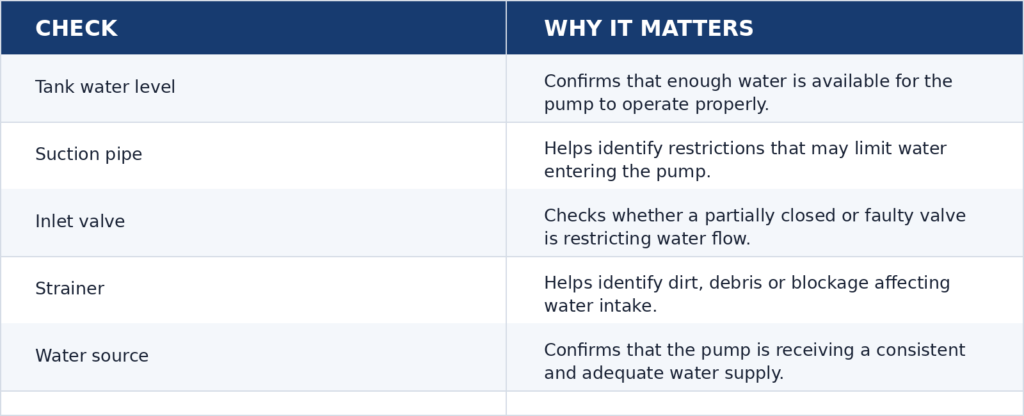
If the water supply itself is inadequate, simply installing a larger pump may not solve the problem.
2. Blocked Filters, Strainers or Pipes
Restrictions in the water path are another common reason for reduced pump performance.
Over time, filters and strainers can collect:
- Dirt
- Sand
- Sediment
- Rust
- Scale
- Other debris
A blocked suction strainer can reduce the amount of water entering the pump. Blockages or excessive resistance elsewhere in the pipework can also affect the system’s flow and pressure.
Signs of a blockage
You may notice:
- Reduced water flow
- Lower pressure
- Longer operating time
- Unusual pump noise
- Pressure fluctuations
- Gradual deterioration in performance
What should you check?
Start with accessible filters and strainers. If they are clean, inspect valves and pipework for restrictions.
A gradual reduction in pump capacity can also be associated with clogged pump hydraulics, non-return valve problems or gradual blockage of the delivery pipe.
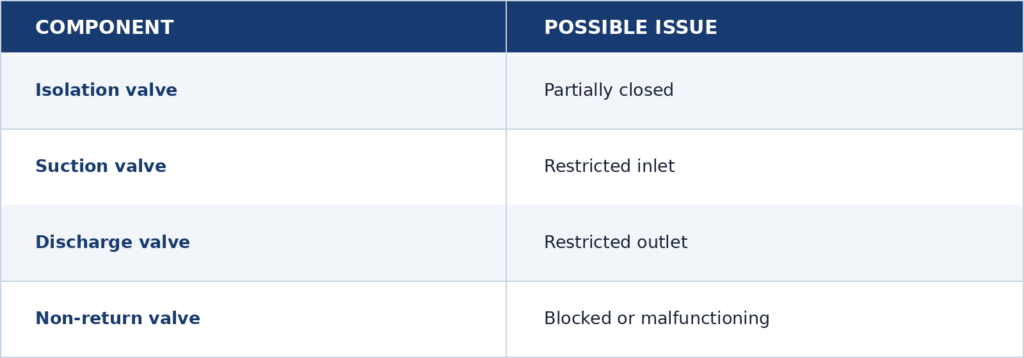
3. Partially Closed or Faulty Valves
Valves regulate water movement through the system. If a valve is partially closed, incorrectly adjusted or malfunctioning, it can restrict flow and affect pressure.
This can happen after maintenance work when a valve has not been completely reopened.
Valves worth checking include:
- Suction valves
- Discharge valves
- Isolation valves
- Non-return/check valves
- Other control valves
4. Air Entering the Suction Line
Air entering the suction side of the pump can interfere with normal water movement and pump operation.
Possible causes include:
- Loose pipe connections
- Damaged seals
- Suction-side leaks
- Poor installation
- Inadequate water level
- Improper suction conditions
Common symptoms
Air-related problems may cause:
- Fluctuating pressure
- Irregular water flow
- Unusual noise
- Vibration
- Loss of prime
- Reduced pump performance
Pump troubleshooting documentation identifies air leakage in suction piping as one possible cause of inadequate discharge pressure.
The suction line should therefore be inspected carefully if a pump is running but not delivering its expected pressure.
5. Incorrect Pump Sizing
Incorrect pump selection is one of the most important causes to consider when a pump consistently fails to meet the required pressure.
A common misconception is that a higher-horsepower pump will automatically provide higher pressure.
Pump selection is more complicated than simply choosing a larger motor.
What determines the right pump?
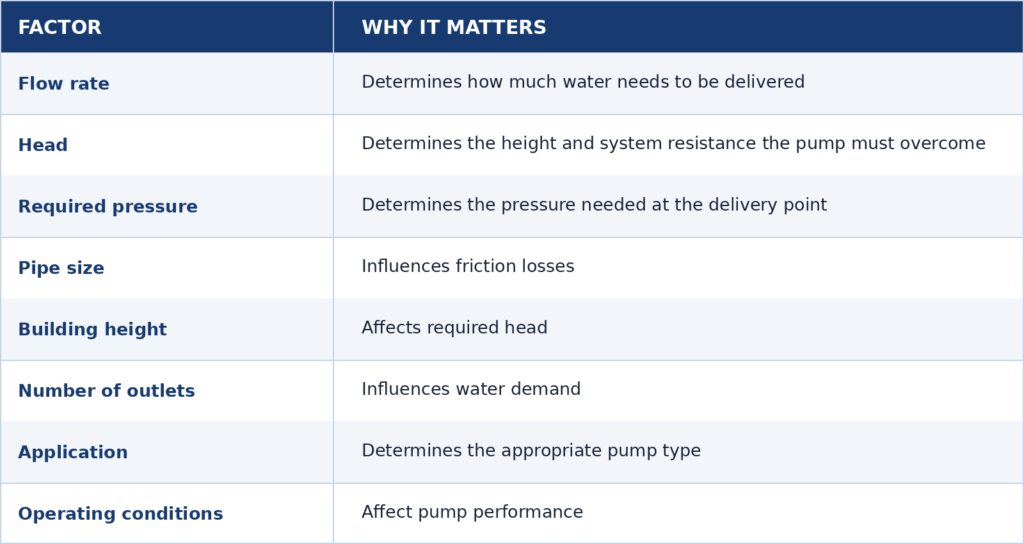
For example, a pump used to transfer water between tanks may have different requirements from a booster system supplying a multi-storey building.
Similarly, an irrigation pump may need to handle different flow and head requirements from a domestic water-supply pump.
Why HP alone is not enough
A pump can be operating correctly but still fail to deliver the expected pressure if it was not selected for the actual system requirements.
The correct approach is to evaluate:
Flow + Head + Pressure + System Resistance + Application
before selecting a pump.
6. Worn or Damaged Pump Components
If a pump has been operating for a long period, its internal components can gradually wear.
Depending on the pump type and operating conditions, components that may require inspection include:
- Impeller
- Shaft
- Bearings
- Mechanical seal
- Coupling
- Motor
- Other hydraulic components
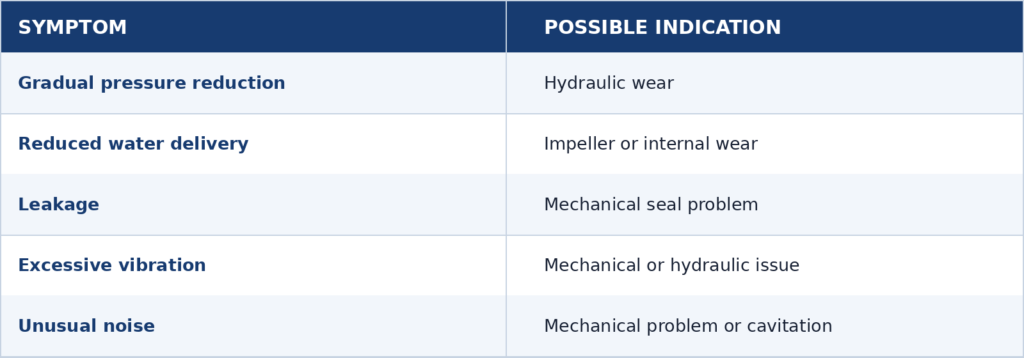
How component wear can affect performance
7. Pressure-Control System Problems
Modern booster and water-pumping systems can include several components that regulate pump operation and system pressure.
These may include:
- Pressure switches
- Pressure sensors
- Pressure gauges
- Pressure tanks
- Control panels
- Variable frequency drives (VFDs)
A problem with one of these components can cause unstable pressure or incorrect pump operation.
Why Does a Booster Pump Keep Starting and Stopping?
Frequent starting and stopping may be associated with:
- Pressure-control settings
- Pressure tank condition
- Water demand
- System leaks
- Incorrect configuration
If a booster system is repeatedly starting and stopping, it is better to diagnose the pressure-control system rather than simply replacing the pump.
8. Leaks, Cavitation and Other Hydraulic Problems
Sometimes the pump is working, but the system is losing pressure elsewhere.
Leaks can occur at:
- Pipe joints
- Flanges
- Valves
- Couplings
- Pump seals
- Connections
A leak can cause the pump to run longer or prevent the system from maintaining its required pressure.
Another important condition is cavitation.
What Is Pump Cavitation?
Cavitation occurs when pressure inside the pump falls sufficiently for vapour bubbles to form and then collapse. It is associated with inadequate net positive suction head available at the pump inlet. Cavitation can produce noise, vibration, performance deterioration and mechanical damage.
Common signs of cavitation
- Unusual noise
- Vibration
- Reduced performance
- Damage to pump components
- Unstable operation
Cavitation is not simply a pump-maintenance problem. Suction conditions, system design and operating conditions can all contribute to it.
If a pump is noisy and losing pressure at the same time, the suction conditions should be investigated.
How to Troubleshoot a Water Pump Losing Pressure
Instead of immediately replacing the pump, work through the system step by step.
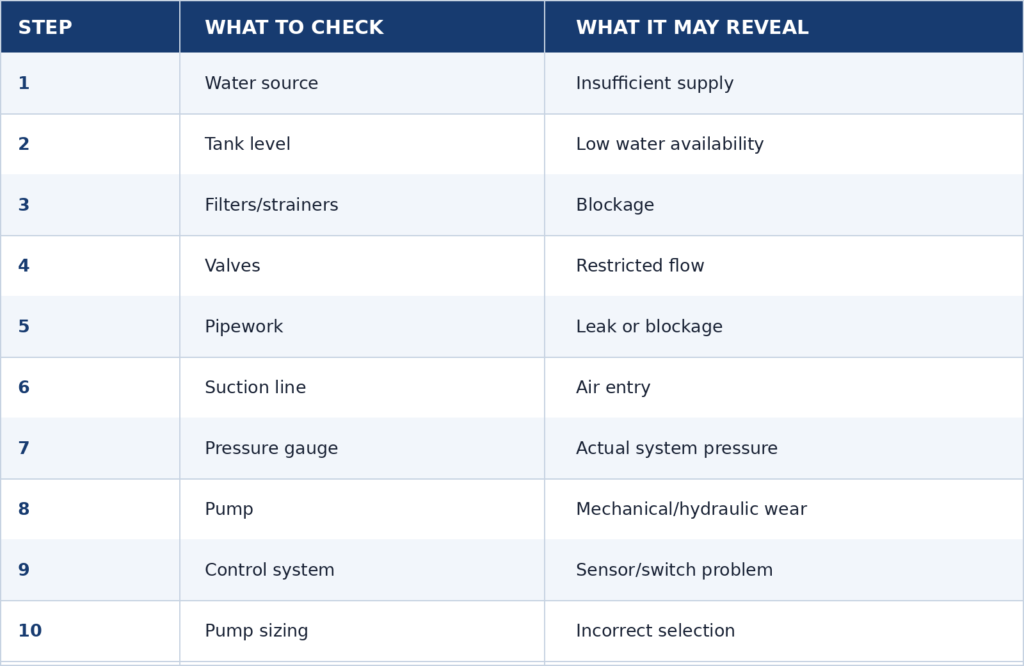
This systematic approach helps determine whether the problem is primarily related to maintenance, hydraulics, mechanical condition, system design or pump selection.
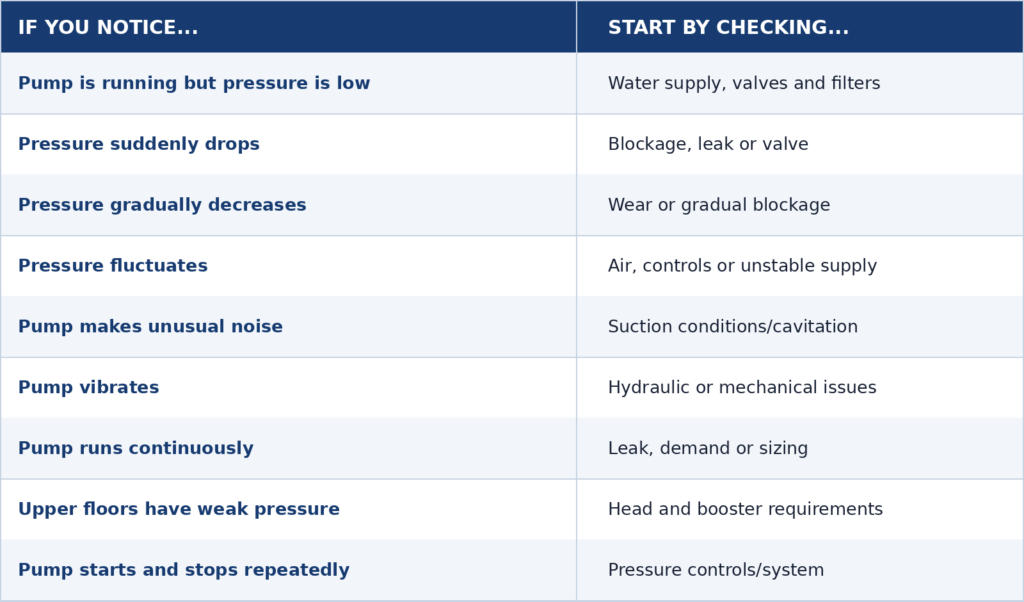
Water Pump Pressure Problem: Quick Diagnosis
When Do You Need a Booster Pump?
A booster pump can be considered when the underlying requirement is to increase or maintain water pressure.
For example, a booster system may be appropriate when:
- Water pressure is inadequate on higher floors.
- Multiple outlets operate simultaneously.
- Existing supply pressure is insufficient.
- A building requires consistent pressure.
- The system needs dedicated pressure boosting.
However, a booster pump should not be treated as the automatic solution to every low-pressure problem.
If the actual issue is a blocked pipe, leaking system, faulty valve or damaged pump, those problems should be addressed first.
Booster Pump vs Transfer Pump: Which One Do You Need?
Booster pumps and transfer pumps serve different purposes.
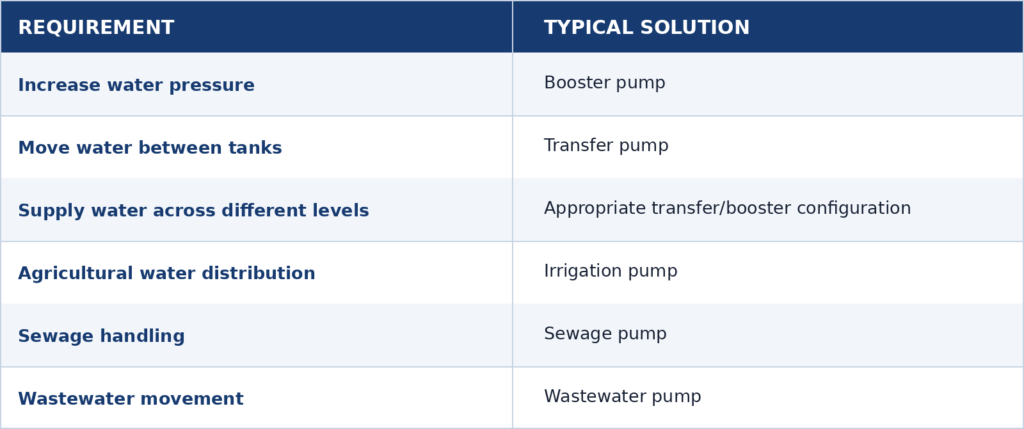
The correct pump depends on the job the pump needs to perform, rather than simply its horsepower rating.
For commercial or industrial systems, the pump set may also include manifolds, valves, non-return valves, pressure tanks, control panels and other components depending on the application.
Should You Repair or Replace Your Water Pump?
Not every pressure problem requires a new pump.
The appropriate solution depends on what is causing the problem.
A pump that is still in good condition may only require maintenance or a component repair. On the other hand, an old or incorrectly sized pump may no longer be the most suitable solution for the application.
How to Prevent Water Pump Pressure Problems
Preventive maintenance can help identify pressure problems before they develop into major failures.
1. Inspect the Pump Regularly
Check for:
- Unusual noise
- Vibration
- Leakage
- Temperature changes
- Changes in water delivery
2. Clean Filters and Strainers
Regular cleaning helps prevent restrictions that can affect pump performance.
3. Monitor Pressure
Keep track of normal operating pressure. A gradual change can provide an early warning that something in the system requires attention.
4. Check for Leaks
Inspect pipe joints, valves, couplings, flanges and pump seals.
5. Monitor Pump Operating Behaviour
Pay attention if the pump:
- Runs continuously
- Starts and stops frequently
- Takes longer to build pressure
- Becomes noisy
- Vibrates more than usual
6. Review Pump Performance Periodically
For commercial and industrial systems, periodic performance assessment can help identify gradual reductions in capacity and potential maintenance requirements.
Choosing the Right Water Pump for Your Application
If the current pump is incorrectly sized or no longer meets the system’s requirements, selecting a replacement should begin with the application’s actual operating conditions.
Before selecting a pump, consider:
- Required flow rate
- Required pressure
- Total head
- Water source
- Pipe dimensions
- Vertical lift
- Number of outlets
- Application
- Operating hours
- Duty/standby requirements
- Electrical requirements
For larger commercial and industrial systems, the complete pump-set configuration may also need to be considered.
This can include:
- Pump arrangement
- Suction and delivery manifolds
- Valves
- NRV/check valves
- Pressure tanks
- Control panels
- Pressure switches
- Pressure gauges
- VFDs
- Base frames
The objective is not simply to select a powerful pump. It is to select a pump system that matches the application’s actual requirements.
Water Pump Solutions for Different Applications
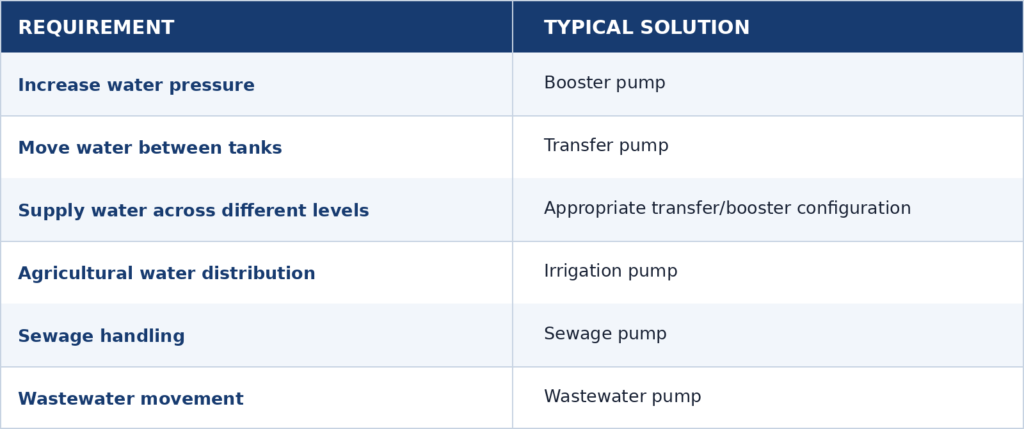
Different water-management requirements call for different pump solutions.
Booster Pumps
Used where the primary requirement is to improve or maintain water pressure for domestic, commercial or industrial water supply systems.
Transfer Pumps
Used to move water between tanks, locations or different levels.
Irrigation Pumps
Used for agricultural and landscaping applications where water needs to be distributed across an irrigation system.
Sewage Pumps
Designed for applications involving sewage and wastewater movement.
Wastewater Pumps
Used for managing wastewater in appropriate residential, commercial and industrial applications.
Choosing the correct pump category is the first step. The next step is determining the required flow, head, pressure and configuration.
When Should You Contact a Pump Specialist?
Professional assistance is recommended when:
- The pump suddenly loses significant pressure.
- The pump is running but water delivery is inadequate.
- The pressure continues to fluctuate.
- The pump repeatedly starts and stops.
- You notice unusual noise or vibration.
- There is visible leakage.
- The pump frequently loses prime.
- Basic checks have not resolved the problem.
- You are unsure whether to repair or replace the pump.
- You need to select a pump for a new building or project.
This is particularly important for commercial and industrial systems, where an incorrectly selected pump can affect the wider water-management system.
How Al Rahmanyah Can Help
The right pump depends on the application, not simply the horsepower rating.
Al Rahmanyah Trading provides water-pumping solutions for different domestic, commercial and industrial requirements, including:
- Booster pumps
- Transfer pumps
- Irrigation pumps
- Sewage pumps
- Wastewater pumps
- Pump sets and related system components
If your pump is losing pressure, you can share details such as your application, existing pump, location, water source, required pressure and current problem with the Al Rahmanyah team.
This information can help determine whether the system requires troubleshooting, maintenance, repair, replacement or a different pump configuration.
Bottom Line
A water pump losing pressure does not necessarily mean that the pump needs to be replaced.
The pressure loss could be caused by something as straightforward as a blocked filter or partially closed valve, or it could involve air entering the suction line, incorrect pump sizing, worn components, pressure-control problems, leakage or cavitation.
The right approach is:
Identify the problem → Inspect the system → Determine the required flow, head and pressure → Repair, reconfigure or replace the pump where necessary.
Most importantly, do not select a replacement pump based on horsepower alone. The new pump should be matched to the actual application and operating requirements.
If your existing pump is no longer delivering the required pressure, a proper assessment can help determine the right solution before you invest in a replacement.
Need help with a water pump that is losing pressure? Contact Al Rahmanyah Trading to discuss your application and pump requirements.
Frequently Asked Questions
Why is my water pump losing pressure?
A water pump may lose pressure because of insufficient water supply, blocked filters or pipes, faulty valves, air entering the suction line, incorrect pump sizing, worn components, pressure-control problems, leaks or cavitation.
Why is my water pump running but the pressure is low?
A pump can run while delivering inadequate pressure if there is a restriction in the suction or discharge system, insufficient water supply, air entering the system, internal wear or incorrect pump selection.
Can a blocked pipe cause low water pressure?
Yes. Blocked or restricted pipes can reduce water flow and increase system resistance, affecting the pressure and capacity available at the delivery point.
Can a booster pump fix low water pressure?
A booster pump can be suitable when the system genuinely requires additional pressure. However, blockages, leaks, faulty valves and pump faults should be diagnosed first.
Does a higher HP pump always provide higher pressure?
No. Pump performance depends on factors including flow, head, system resistance, pump design and operating conditions. A higher-horsepower pump is not automatically the correct solution.
Why does my booster pump keep starting and stopping?
Frequent starting and stopping may be associated with pressure controls, pressure-tank conditions, system demand, leaks or incorrect configuration. The complete system should be inspected.
How do I know if my water pump needs repair or replacement?
Consider the pump’s age, condition, component wear, repair requirements and whether it can still meet the application’s required flow and pressure. A technical assessment can help determine the appropriate option.
How do I choose the right replacement water pump?
Start with the required flow rate, head and pressure. Then consider the water source, pipework, building height, number of outlets, application and operating conditions.
Why is my pump making noise after losing pressure?
Unusual noise together with pressure loss can indicate air entering the system, cavitation, mechanical wear or another hydraulic problem. The cause should be investigated rather than ignored.
When should I contact a pump specialist?
Contact a pump specialist when pressure problems persist, the pump repeatedly fails, there is significant leakage, unusual noise or vibration, or you need help selecting a pump for a new or existing system.