




TL;DR
The right booster pump for a villa in Dubai depends on the required water flow, pressure, building height, number of outlets, existing water supply, pipe size and expected usage. Instead of choosing a pump based only on horsepower, assess the complete water system and select a pump that can deliver the required flow and pressure under actual operating conditions.
Choosing a booster pump for a villa in Dubai is not simply a matter of selecting a higher horsepower pump. The right booster pump needs to match the villa’s water demand, building height, required pressure, pipework, number of outlets and existing water supply.
A pump that is too small may not provide adequate pressure when multiple outlets are used. A pump that is oversized may consume unnecessary energy and create pressure or cycling problems.
For villa owners, facility managers and contractors, the key is to determine how much water is required, how much pressure is needed, and how the existing water system is configured before selecting the pump.
What Is a Booster Pump?
A booster pump is used to increase water pressure within a water supply system when the existing pressure is not sufficient for the building’s requirements.
In a villa, a booster pump may be required when:
- Water pressure is weak at showers or taps
- Upper floors receive insufficient pressure
- Pressure drops when several outlets operate simultaneously
- The existing water supply cannot maintain the required pressure
- Water needs to be distributed consistently throughout the villa
- The villa has multiple bathrooms or high water demand
Booster pump systems can be configured according to the application’s flow and pressure requirements.
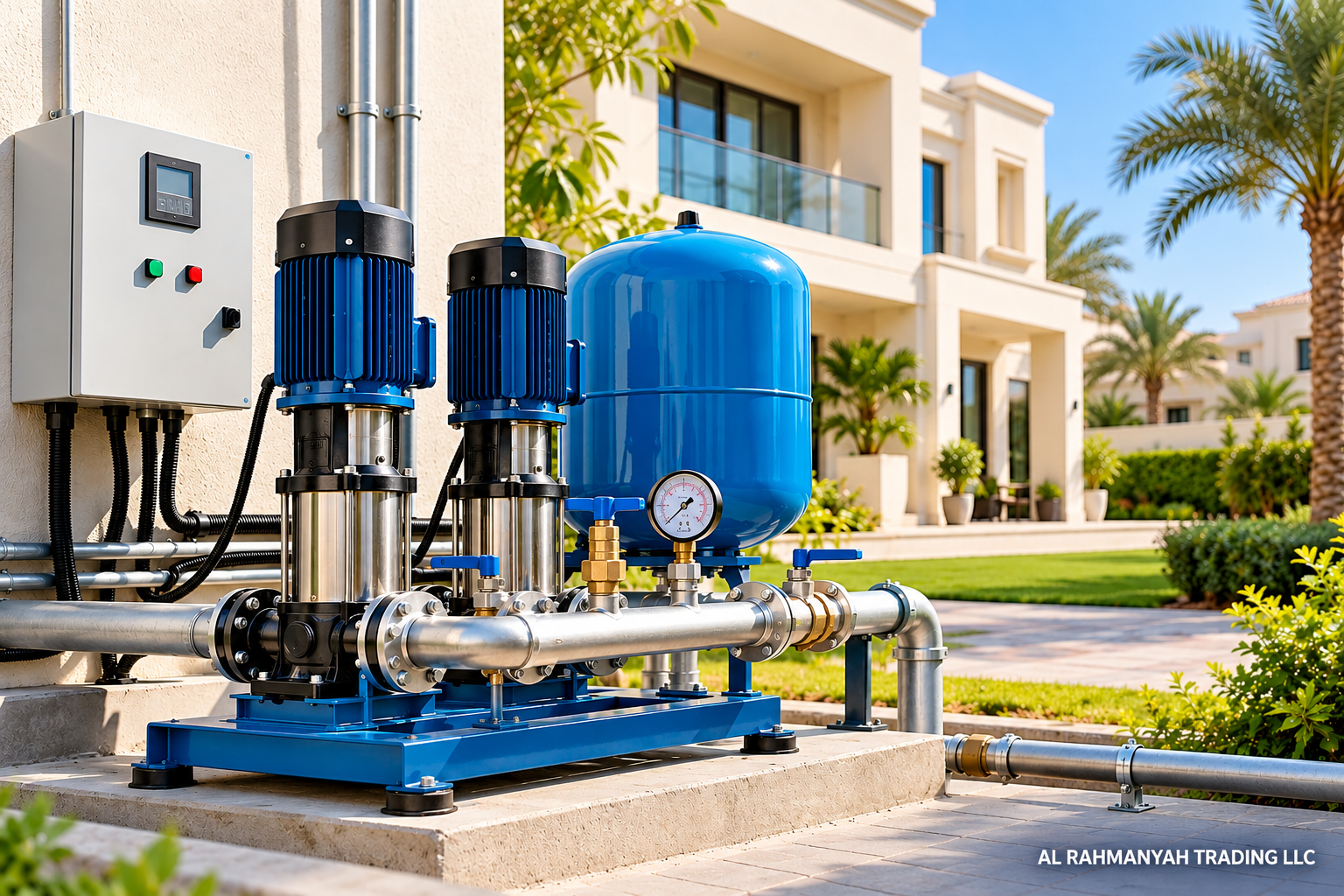
For larger or more demanding systems, a booster pump set may include components such as multiple pumps, manifolds, pressure tanks, control panels, valves, non-return valves, pressure gauges and other accessories.
Why Do Villas in Dubai Need Booster Pumps?
Water pressure requirements can vary considerably between villas depending on their size, number of floors, plumbing configuration and water usage.
For example, a villa may have:
- Multiple bathrooms
- Several showers
- Kitchen outlets
- Outdoor taps
- Garden irrigation
- Water heaters
- Multiple occupants
- Water outlets operating at the same time
If the incoming pressure is insufficient, the system may perform well when only one tap is open but experience a significant pressure drop when several outlets are used.
This is why actual water demand is more important than simply looking at the size of the villa.
What Should You Consider Before Choosing a Booster Pump?
There are several factors that should be evaluated before selecting the pump.
1. Determine the Required Water Flow
Flow rate refers to the amount of water the pump needs to deliver over a specific period.
For a villa, the required flow depends on the number of fixtures and how many are likely to operate simultaneously.
For example, consider a villa with:
- Multiple bathrooms
- Several shower points
- Kitchen outlets
- Outdoor water points
- Additional water-consuming appliances
The pump should be selected based on the expected simultaneous demand, rather than simply adding up every outlet in the villa.
If the pump cannot provide sufficient flow at the required pressure, occupants may still experience weak water pressure.
2. Calculate the Required Pressure
The pump also needs to provide sufficient pressure at the points where water is being used.
Required pressure can be influenced by:
- Building height
- Vertical distance between the water source and outlet
- Pipe friction
- Number of outlets
- Required pressure at fixtures
- Existing inlet pressure
A villa with multiple floors will generally have different pressure requirements from a single-storey property.
The objective is not to maximise pressure. It is to achieve the required operating pressure for the system.
3. Consider the Villa’s Building Height
Building height is an important part of pump selection.
Water needs to travel vertically through the plumbing system, and additional head is required to overcome this elevation as well as resistance within the pipework.
For a multi-storey villa, the pump selection should therefore account for:
Static height + pipe friction losses + required outlet pressure
This is one reason why selecting a pump purely by horsepower can lead to incorrect sizing.
4. Check the Existing Water Supply
Before installing a booster pump, determine where the water is coming from.
The system could receive water from:
- A storage tank
- Municipal supply
- An existing pump
- A combination of supply sources
The booster pump must have an adequate water supply on its suction side.
If the incoming supply is restricted or the tank does not provide enough water, simply installing a larger booster pump may not solve the problem.
5. Check the Pipe Size
Pipe diameter affects the performance of the entire water system.
If the pipework is too small for the required flow, friction losses can increase and reduce the pressure available at the outlets.
Therefore, pump selection should consider:
- Suction pipe size
- Discharge pipe size
- Pipe length
- Number of bends
- Valves and fittings
- Existing plumbing configuration
A correctly selected pump connected to an unsuitable pipe system may still fail to deliver the expected performance.
6. Consider the Number of Bathrooms and Water Outlets
The number of outlets provides an indication of potential water demand.
However, not every outlet will normally operate at the same time.
For example, a large villa with six bathrooms does not necessarily require a pump sized for six showers operating continuously.
A pump specialist can estimate the probable simultaneous demand and select the system accordingly.
7. Consider Peak Water Demand
Villa water consumption can change throughout the day.
Morning and evening periods may have greater demand because several people may use showers, bathrooms and kitchen facilities around the same time.
The booster system should therefore be capable of handling the expected peak demand without excessive pressure fluctuations.
8. Don’t Choose the Pump Based Only on Horsepower
This is one of the most common mistakes when selecting a water pump.
A higher-horsepower motor does not automatically mean the pump is suitable for your villa.
Two pumps with similar motor power can have different performance characteristics depending on their hydraulic design.
The selection should consider:
Flow + Head + Required Pressure + Application + System Conditions
Horsepower should be considered as part of the pump specification, not as the only selection criterion.
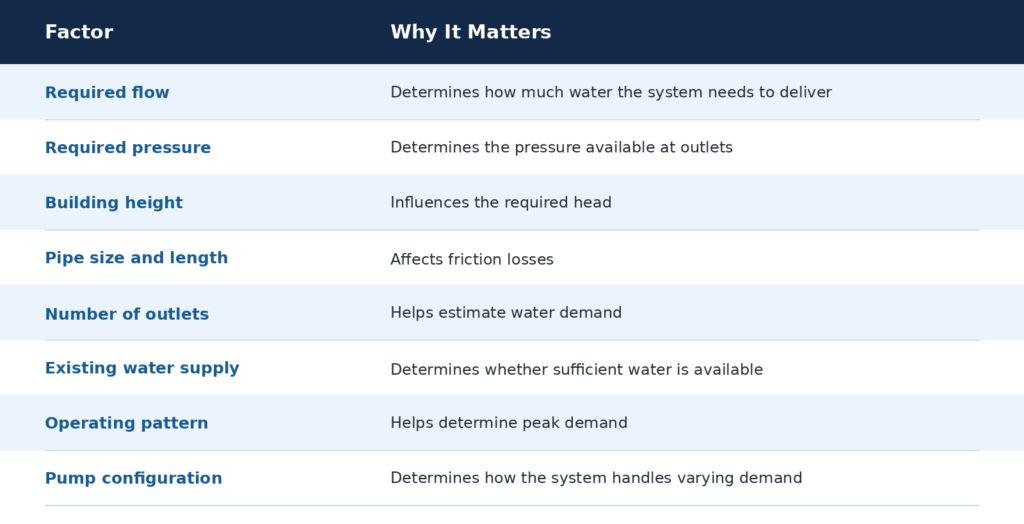
Booster Pump Selection: Key Factors
What Size Booster Pump Does a Villa Need?
There is no single booster pump size that works for every villa in Dubai.
The required capacity depends on the individual water system.
For example, a small villa with limited water demand may require a very different pump from a large multi-storey villa with several bathrooms, multiple occupants and extensive outdoor water requirements.
Instead of asking:“How many HP should my booster pump be?”
the better question is:“What flow and pressure does my villa’s water system actually require?”
This approach helps avoid both undersizing and unnecessary oversizing.
Single Booster Pump or Duty-Standby System?
For some villas, a single pump may be sufficient.
For larger properties or systems where continuity of water supply is important, a duty-standby configuration may be considered.
In a duty-standby system, one pump operates as the primary pump while the second pump can provide backup when required.
This can be useful where:
- Water supply continuity is important
- The property has higher demand
- The system needs redundancy
- Maintenance needs to be carried out without completely stopping the water supply
The appropriate configuration depends on the villa’s application and operating requirements.
What Is Included in a Booster Pump Set?
A booster pump is not necessarily just the pump and motor.
A complete booster pump set can include several components designed to work together.
Depending on the system, these may include:
- Pump or multiple pumps
- Suction and delivery manifolds
- Pressure tank
- Control panel
- PLC or VFD
- Valves
- Non-return valves
- Y-strainer
- Flexible connections
- Pressure switch
- Pressure gauge
- Base frame
The exact configuration should be determined according to the application’s requirements.
Common Mistakes When Choosing a Villa Booster Pump
Choosing Based Only on HP
A higher-power pump may not deliver the correct flow-pressure combination for the system.
- Ignoring Building Height
The pump must overcome the vertical elevation between the water source and the highest required outlet.
- Ignoring Existing Pipework
Small or restricted pipes can limit system performance even when the pump itself is appropriately sized.
- Selecting an Oversized Pump
Oversizing can result in unnecessary energy consumption, pressure issues and undesirable operating behaviour.
- Ignoring Peak Demand
A system that works when one shower is running may not perform adequately when several outlets are used simultaneously.
- Replacing the Pump Without Diagnosing the Problem
Low pressure may also result from blocked filters, closed valves, leaks, inadequate water supply or other system problems.
How to Know If Your Villa Needs a Booster Pump
A booster pump may be worth considering if you consistently experience:
- Weak shower pressure
- Poor pressure on upper floors
- Pressure dropping when multiple taps are opened
- Inconsistent water pressure
- Slow water delivery
- Insufficient pressure for certain fixtures
- Water pressure that varies significantly throughout the property
However, the first step should be identifying why the pressure is low.
If a blocked pipe or faulty valve is causing the problem, installing a larger pump may not be the appropriate solution.
Booster Pump vs Transfer Pump for a Villa
These two pump types can serve different purposes.
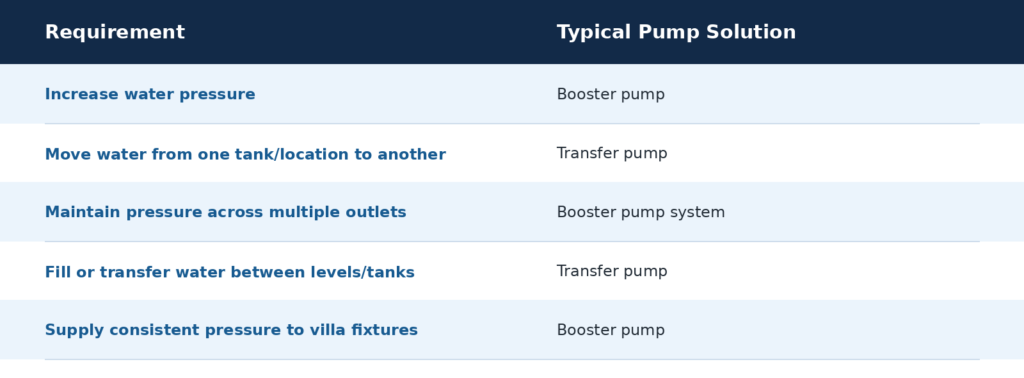
A transfer pump primarily moves water from one location to another, while a booster pump is generally used to increase or maintain pressure within a water supply system.
In some properties, both types of pumps may be required for different parts of the water system.