




TL;DR
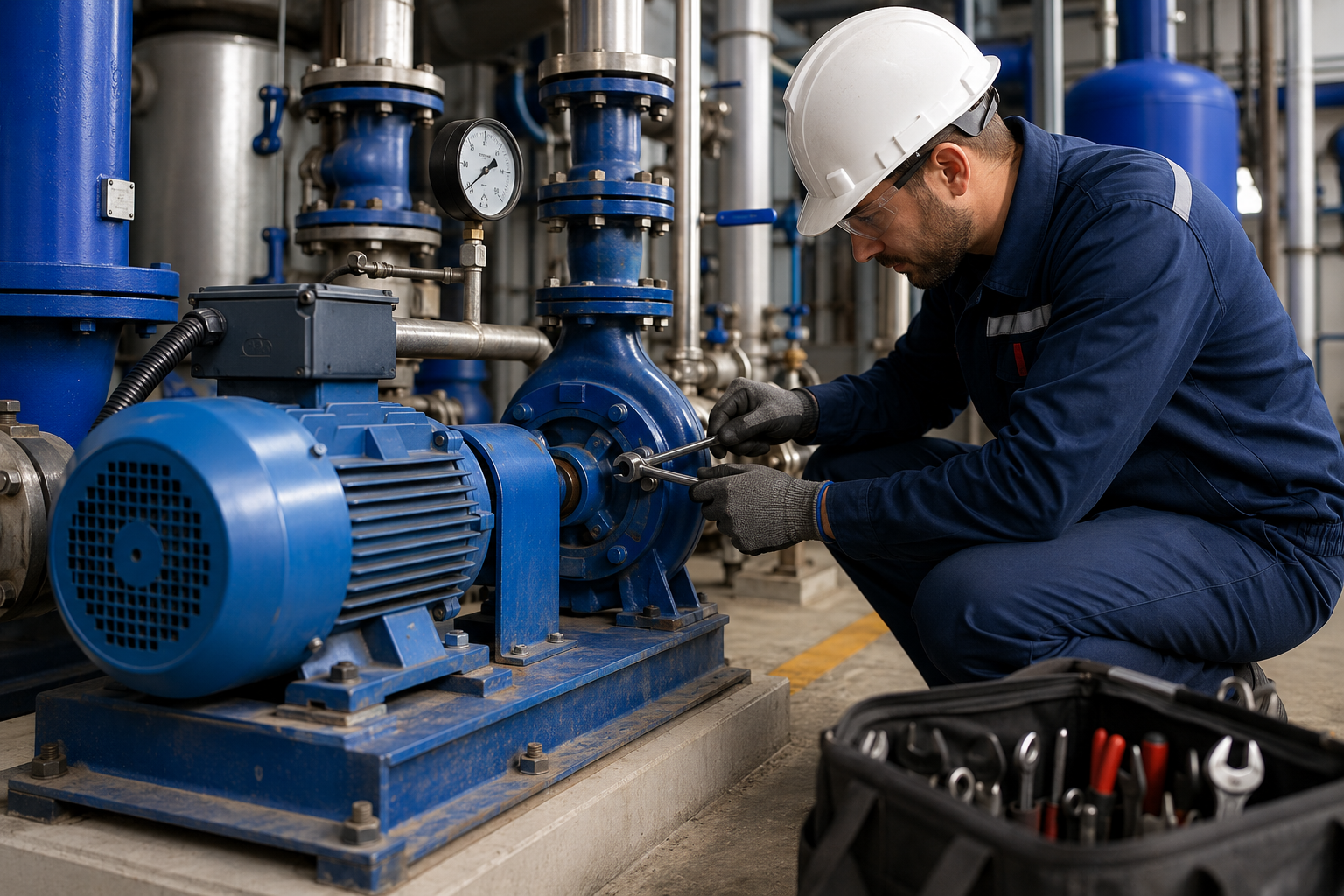
Regular pump maintenance is essential for ensuring reliable performance, reducing energy consumption, and extending the service life of residential, commercial, and industrial pumping systems. This guide covers the most common pump problems, including low pressure, overheating, leakage, excessive vibration, and motor failure, along with practical troubleshooting techniques and preventive maintenance recommendations. You’ll also find a routine maintenance checklist, an annual servicing schedule, pressure vessel inspection guidelines, and best practices for maintaining water pumps under the UAE’s demanding operating conditions. Whether you’re responsible for a booster pump, centrifugal pump, or industrial pumping system, following these maintenance practices can help minimize downtime, improve efficiency, and reduce long-term repair costs.
Pump Repairing & Maintenance Guide for Residential, Commercial & Industrial Water Pump Systems
Water pumps play a critical role in maintaining uninterrupted water supply across residential buildings, commercial facilities, industrial plants, agricultural systems, and infrastructure projects throughout the UAE. Whether installed in booster systems, HVAC networks, firefighting systems, or water treatment plants, pumps operate continuously under demanding conditions.
Without regular inspection and preventive maintenance, pump performance gradually deteriorates due to component wear, contamination, improper operating conditions, or electrical faults. These issues often lead to reduced efficiency, pressure fluctuations, increased energy consumption, and unexpected equipment failure.
Implementing a structured maintenance program helps improve operational reliability, extend equipment life, reduce repair costs, and minimize unplanned downtime. Regular servicing also ensures that pumping systems continue to operate within manufacturer specifications while maintaining safety and performance standards.
This guide provides practical maintenance recommendations, troubleshooting procedures, inspection schedules, and repair guidelines applicable to most residential, commercial, and industrial pumping systems operating in the UAE.
Importance of Routine Pump Maintenance
Routine maintenance is one of the most effective methods for maximizing pump efficiency and preventing premature equipment failure. Pumps operating under continuous load are exposed to mechanical wear, electrical stress, temperature fluctuations, and water quality issues that gradually affect performance.
A preventive maintenance program allows potential faults to be identified before they develop into major failures requiring costly repairs or complete equipment replacement.
Benefits of Routine Pump Maintenance
- Improves hydraulic efficiency
- Reduces energy consumption
- Extends equipment service life
- Minimizes unexpected downtime
- Reduces emergency repair costs
- Improves operational safety
- Maintains consistent water pressure
- Protects motors and electrical components
- Ensures reliable system performance
For commercial buildings and industrial facilities, preventive maintenance also reduces operational interruptions and helps maintain compliance with facility maintenance standards.
Pump Components That Require Regular Inspection
Routine inspection should include all major mechanical and electrical components that influence pump performance.
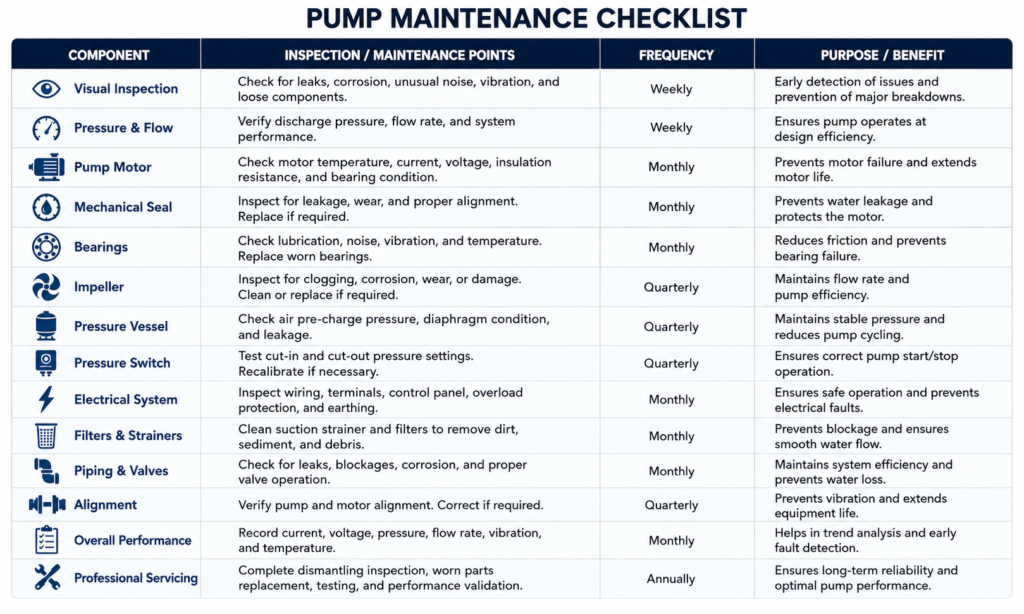
Any abnormal condition observed during inspection should be investigated immediately to prevent further damage.
Routine Pump Maintenance Checklist
A structured maintenance schedule improves equipment reliability and reduces the likelihood of emergency breakdowns.
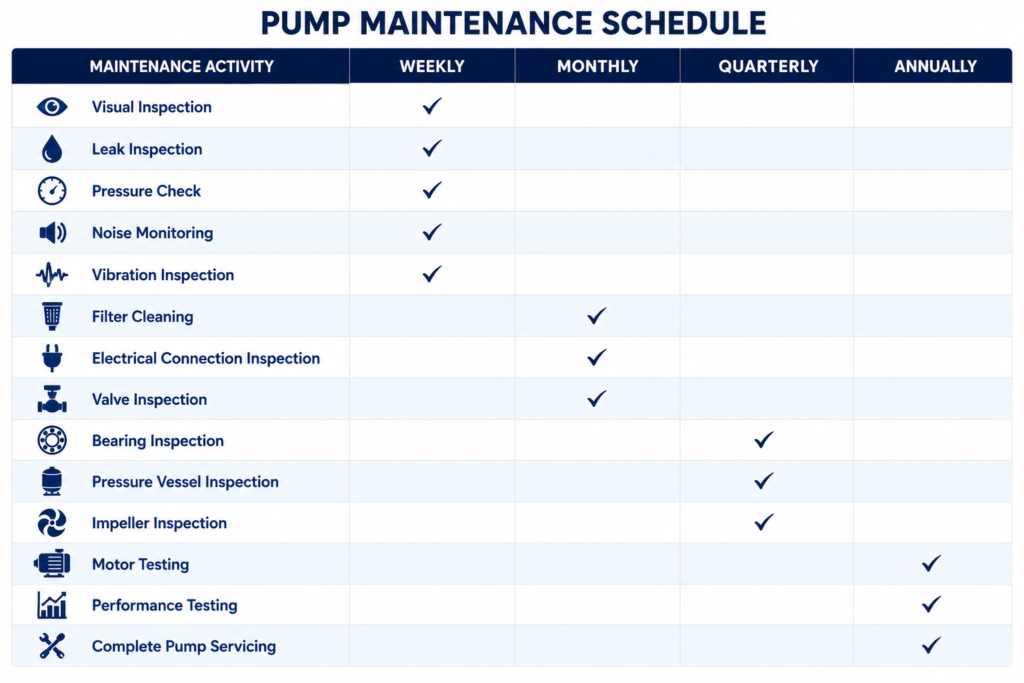
Weekly Maintenance
Perform the following visual and operational checks:
- Inspect pump body for water leakage.
- Check system pressure.
- Observe pump start and stop operation.
- Listen for unusual noise.
- Inspect vibration levels.
- Check pressure gauge readings.
- Verify normal water flow.
- Inspect suction and discharge piping.
Monthly Maintenance
Monthly inspections should include preventive servicing activities.
- Clean suction strainers and filters.
- Tighten electrical terminals.
- Inspect pressure switches.
- Inspect valves for leakage.
- Check pump alignment.
- Clean ventilation openings.
- Inspect electrical control panel.
- Verify pressure vessel performance.
- Inspect cable insulation.
Quarterly Maintenance
Quarterly servicing should involve more detailed mechanical inspections.
- Inspect impeller wear.
- Check mechanical seal condition.
- Measure motor insulation resistance.
- Inspect bearings.
- Test pressure vessel air pre-charge.
- Inspect pipe supports.
- Verify vibration levels.
- Test overload protection.
Annual Maintenance
Annual servicing should be carried out by qualified technicians.
Typical annual maintenance includes:
- Complete pump dismantling (where required)
- Motor performance testing
- Bearing replacement if necessary
- Mechanical seal replacement
- Impeller inspection
- Pressure vessel testing
- Pressure switch calibration
- Electrical safety inspection
- Flow and pressure performance testing
- Final commissioning
Annual servicing helps restore system performance and identifies components approaching the end of their service life.
Pump Maintenance Schedule
Operating Conditions That Affect Pump Performance in the UAE
Pump systems installed in the UAE operate under environmental conditions that require more frequent inspection than many other regions.
Factors affecting equipment performance include:
- High ambient temperatures
- Continuous operation during summer months
- Dust accumulation
- Hard water scaling
- Sand contamination
- High operating pressure
- Outdoor exposure to UV radiation
These conditions increase wear on bearings, seals, motors, impellers, and pressure vessels, making preventive maintenance essential for long-term reliability.
Best Practices for Routine Pump Maintenance
To maintain optimum pump performance:
- Maintain manufacturer-recommended operating pressure.
- Keep pump rooms clean and well ventilated.
- Monitor vibration and unusual operating noise.
- Inspect for leaks during every inspection.
- Replace worn seals before leakage increases.
- Clean suction filters regularly.
- Avoid dry running.
- Record maintenance activities for future reference.
- Schedule annual servicing by qualified technicians.
Common Pump Problems and How to Fix Them
Pump failures are often preceded by minor performance issues that, if identified early, can be resolved before causing significant operational downtime. Understanding the root causes of common pump problems enables facility managers and maintenance teams to implement timely corrective actions and improve system reliability.
The following are some of the most common pump issues encountered in residential, commercial, and industrial water systems.
- Low Water Pressure
Low discharge pressure is one of the most frequently reported pump performance issues. It can affect water distribution systems, irrigation networks, HVAC applications, and industrial processes.
- Pump Not Starting
Failure to start is generally associated with electrical faults or motor-related issues.
- Pump Overheating
Excessive motor temperature significantly reduces motor life and can result in permanent failure.
- Excessive Pump Noise
Abnormal noise often indicates internal mechanical wear.
- Excessive Vibration
Continuous vibration accelerates wear on bearings, seals, couplings, and pipe supports.
- Water Leakage
Water leakage not only wastes water but also damages motors, electrical systems, and surrounding equipment.
- Pump Running Continuously
A pump that never shuts off consumes excessive electricity and shortens equipment life.
- Cavitation
Cavitation is one of the most destructive hydraulic conditions affecting centrifugal pumps. It occurs when vapor bubbles form inside the pump due to insufficient suction pressure and collapse as they move through the impeller.
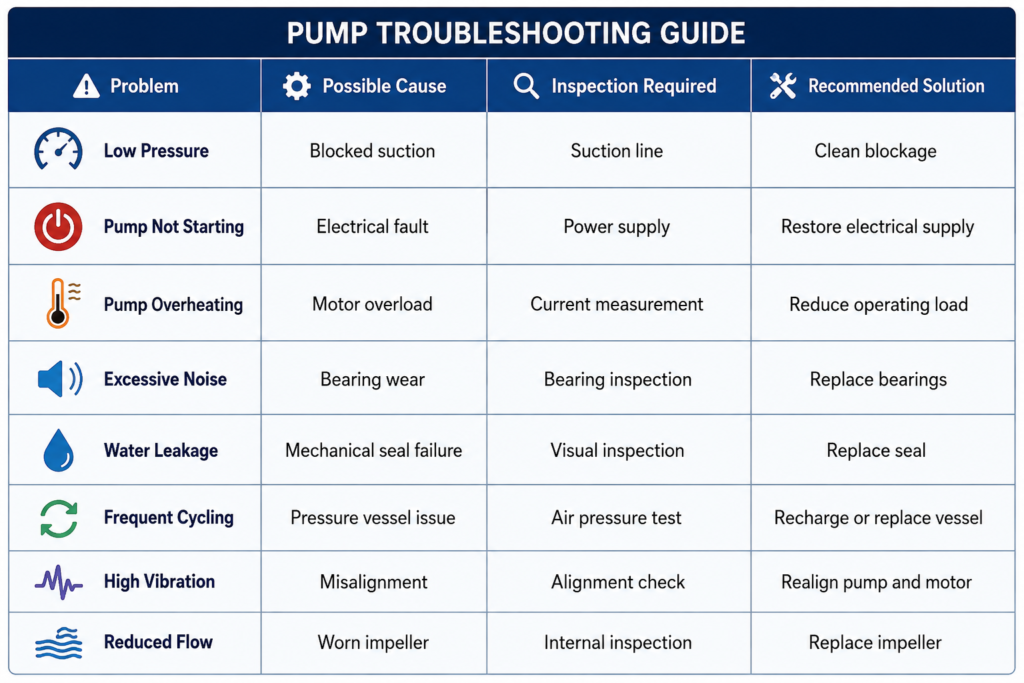
Pump Troubleshooting Guide
The following troubleshooting matrix can be used during routine inspections.
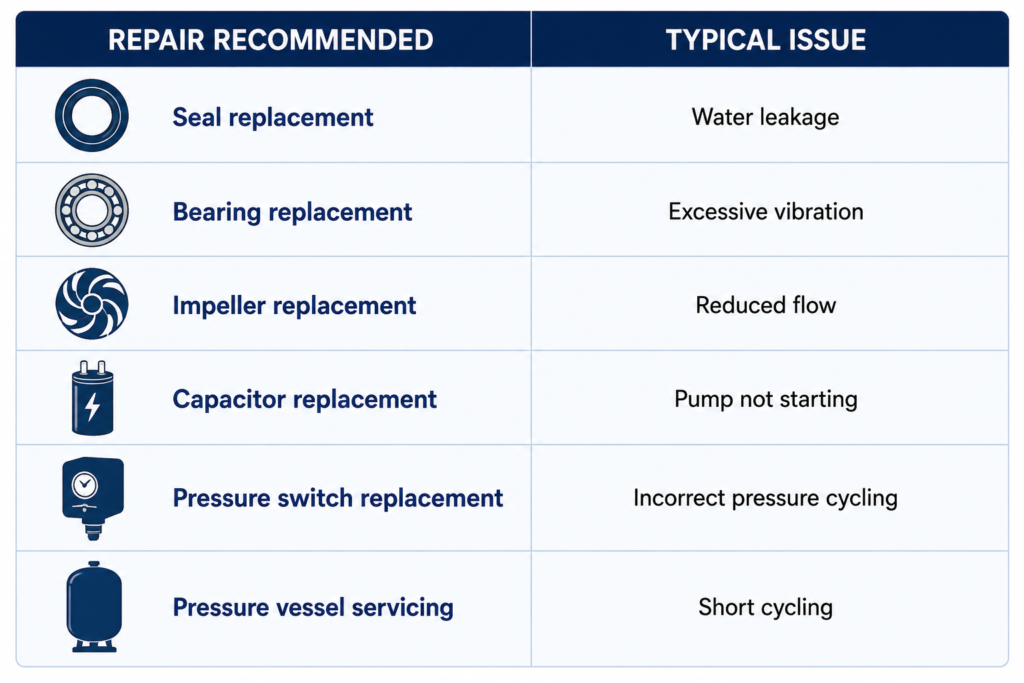
Water Pump Repair Guide
Minor pump faults can often be repaired without replacing the entire unit. However, repairs should always be performed by qualified technicians using manufacturer-approved spare parts.
Repairs Typically Performed
- Mechanical seal replacement
- Bearing replacement
- Impeller replacement
- Pressure switch replacement
- Motor rewinding
- Shaft replacement
- Coupling replacement
- Pressure vessel servicing
- Electrical cable replacement
- Control panel repair
When Should a Pump Be Repaired?
Repair is generally recommended when the damage is localized and the pump body and motor remain structurally sound.
When Should a Pump Be Replaced?
Replacement becomes the more economical option when repair costs approach or exceed the value of the equipment.
Consider replacing the pump if:
- Motor winding is extensively damaged.
- Pump casing is cracked or heavily corroded.
- Multiple components have failed simultaneously.
- Spare parts are no longer available.
- The pump no longer meets operational requirements.
- Energy consumption has significantly increased due to equipment age.
Annual Pump Maintenance Guide
While routine inspections help identify minor issues, annual maintenance provides a comprehensive evaluation of the entire pumping system. An annual service should be performed by qualified technicians using manufacturer-recommended procedures and calibrated testing equipment. This ensures the pump continues to operate efficiently, safely, and within its designed performance parameters.
Regular annual maintenance helps:
- Maximize pump efficiency
- Reduce emergency breakdowns
- Extend equipment service life
- Improve energy efficiency
- Detect hidden mechanical and electrical faults
- Ensure compliance with manufacturer maintenance recommendations
Pressure Vessel Inspection During Pump Maintenance
Pressure vessels play a critical role in maintaining stable water pressure, minimizing pump cycling, and protecting the overall pumping system. Failure to inspect pressure vessels regularly can result in pressure fluctuations, reduced pump efficiency, and premature motor wear.
Preventive Maintenance vs Corrective Maintenance
Organizations that implement preventive maintenance programs generally experience fewer breakdowns, lower repair costs, and improved operational efficiency compared to reactive maintenance strategies.
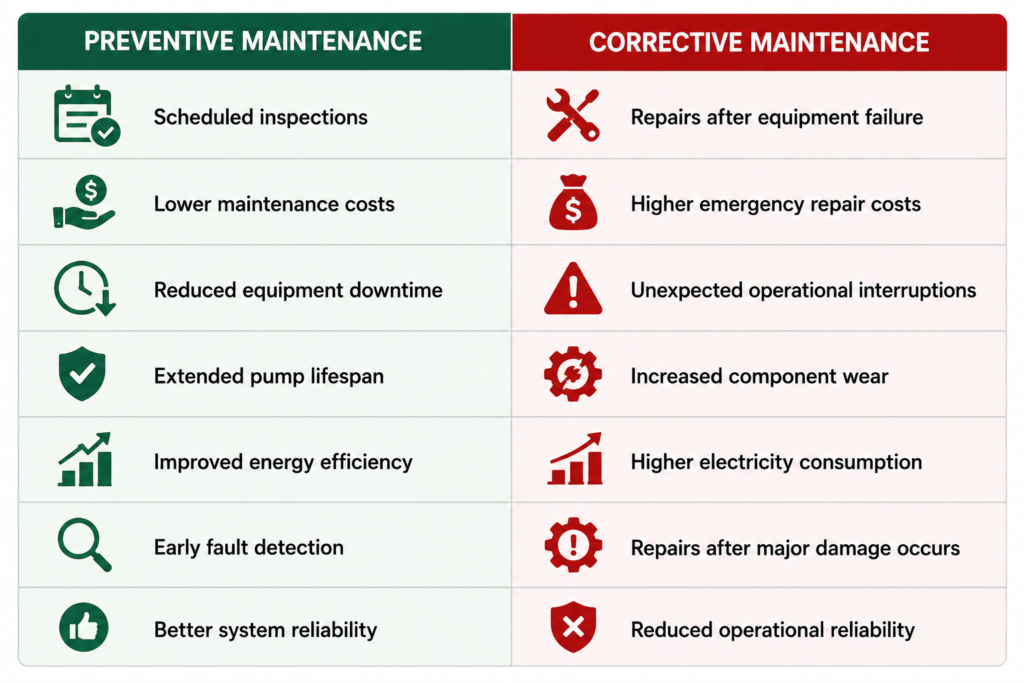
Implementing a preventive maintenance schedule helps identify issues before they escalate into costly failures.
Pump Maintenance Best Practices for UAE Conditions
Pump systems operating in the UAE are exposed to harsh environmental conditions that accelerate component wear and reduce equipment performance. A maintenance program should therefore consider local operating conditions.
High Ambient Temperatures
High summer temperatures increase motor operating temperatures and reduce cooling efficiency. Ensure adequate ventilation around the pump and regularly monitor motor temperature during operation.
Hard Water Scaling
Water with high mineral content can cause scaling on impellers, mechanical seals, and internal pipe surfaces, reducing flow rate and hydraulic efficiency.
Dust and Sand Contamination
Dust and airborne sand particles may enter pump rooms or accumulate around cooling vents, affecting motor cooling and bearing life.
Continuous Duty Operation
Commercial buildings, hotels, hospitals, and industrial facilities often operate pumps continuously.
Best Practices to Extend Pump Life
Following these maintenance practices can significantly improve pump reliability and reduce lifecycle costs.
- Never operate the pump without water (dry running).
- Maintain proper suction conditions.
- Keep filters and strainers clean.
- Monitor vibration and unusual operating noise.
- Replace worn seals before leakage becomes excessive.
- Lubricate bearings according to manufacturer recommendations.
- Record maintenance activities for future reference.
- Replace damaged components using genuine spare parts.
- Schedule annual servicing by qualified pump technicians.
Why Annual Maintenance Contracts (AMC) Are Recommended
For commercial and industrial facilities, Annual Maintenance Contracts (AMC) provide a structured approach to pump maintenance, reducing the risk of unexpected equipment failures.
Typical AMC services include:
- Scheduled preventive inspections
- Routine servicing
- Emergency breakdown support
- Pump performance testing
- Electrical safety inspections
- Pressure vessel servicing
- Spare parts replacement (where applicable)
- Maintenance reporting and recommendations
An AMC helps improve equipment reliability while reducing maintenance costs over the long term.
Why Choose Al Rahmanyah Trading for Pump Repair & Maintenance Services in the UAE?
With years of experience in supplying, installing, repairing, and maintaining water pumping systems, Al Rahmanyah Trading provides reliable pump solutions for residential, commercial, and industrial applications across the UAE. Our qualified technicians follow industry best practices and manufacturer recommendations to ensure every pump system operates safely, efficiently, and reliably.
Whether you require preventive maintenance, emergency repairs, or complete system upgrades, our team delivers prompt service with a focus on minimizing downtime and maximizing equipment performance.
Frequently Asked Questions
1. How often should a water pump be serviced?
Routine visual inspections should be carried out weekly, preventive maintenance should be performed monthly, and a comprehensive inspection by qualified technicians is recommended annually. Pumps operating under continuous duty or harsh environmental conditions may require more frequent servicing.
2. What are the most common causes of pump failure?
Common causes include mechanical seal failure, bearing wear, impeller damage, electrical faults, dry running, cavitation, pressure switch malfunction, inadequate lubrication, and poor preventive maintenance.
3. Can a leaking water pump be repaired?
Yes. In many cases, leaks are caused by worn mechanical seals, damaged gaskets, loose fittings, or deteriorated O-rings. These components can often be replaced without replacing the entire pump.
4. How long does a water pump typically last?
The service life of a water pump depends on the operating environment, maintenance practices, water quality, and usage. With regular preventive maintenance, many pumps provide reliable performance for several years.
5. Is annual pump maintenance necessary?
Yes. Annual maintenance includes detailed inspections, performance testing, calibration, and replacement of worn components. It helps improve reliability, reduce operating costs, and extend equipment lifespan.
6. How can I schedule a pump inspection or repair service?
You can contact Al Rahmanyah Trading to schedule a site inspection, preventive maintenance visit, emergency repair, or request a customized Annual Maintenance Contract based on your facility’s operational requirements.
Conclusion
Routine pump maintenance is essential for ensuring the reliability, efficiency, and longevity of residential, commercial, and industrial pumping systems. Implementing a structured preventive maintenance program helps identify potential issues before they develop into major equipment failures, reducing downtime, lowering operating costs, and improving overall system performance.
Regular inspections of critical components such as mechanical seals, bearings, impellers, motors, pressure vessels, and electrical systems enable organizations to maintain optimal water pressure, improve energy efficiency, and extend the operational life of their equipment.
Whether you require routine servicing, emergency repairs, pressure vessel maintenance, or a comprehensive Annual Maintenance Contract (AMC), partnering with experienced professionals ensures your pumping systems continue to operate safely and efficiently.
Al Rahmanyah Trading provides end-to-end pump repair and maintenance services across the UAE, backed by experienced technicians, quality workmanship, and a commitment to reliable customer support. Contact our team today to schedule a pump inspection or discuss a maintenance solution tailored to your residential, commercial, or industrial requirements.